Quick answer: Mark each sentence in an AI-generated summary as a fact from a source, an interpretation made under stated assumptions, or a proposed next action. Then attach a source location, calculation, or decision owner as appropriate. A label helps organize review; it does not replace reading the source.
This article uses a fictional event-planning note: “24 people registered for an information session; 30 seats are prepared.” The example is a writing exercise, not a measured attendance report.
Give each sentence one role
| Role | Example sentence | What to check |
|---|---|---|
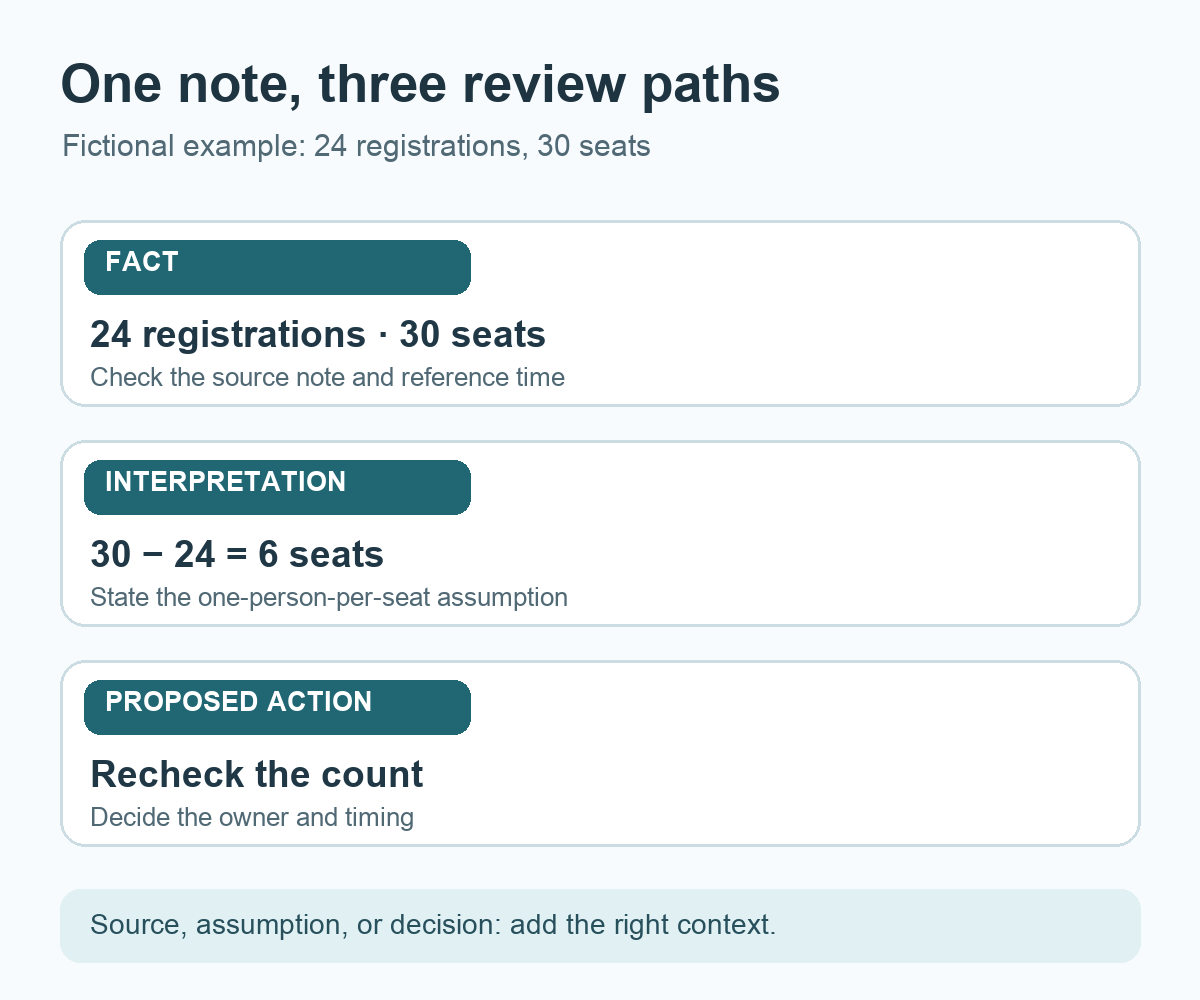
| Fact | The note records 24 registrations and 30 prepared seats. | Locate both numbers in the note. |
| Interpretation | Six seats remain under a one-person-per-seat assumption. | Show 30 minus 24 and the seating assumption. |
| Proposal | Recheck the registration count before the session. | Name the source list and who will decide the timing. |
The second sentence contains a calculation and a condition. If staff members also use the 30 seats, the available-seat number must be recalculated with that scope. The third sentence is a suggestion for work to plan, not a promise that someone has accepted the assignment.
Add a pointer and a reference time to facts
For the 24 registrations, record which list or page supplied the number and when it was checked. If the fictional note has no reference time, write “reference time to confirm” beside the sentence. A link alone is only a pointer; open the destination and locate the cited number before sharing a claim based on it.
For a derived number, show the expression 30 − 24 = 6 and define the count: prepared seats minus registered people. State whether volunteers, speakers, walk-ins, or cancellations belong in that count. The reader can then see exactly how a later change in scope affects the conclusion.
Turn recommendations into reviewable decisions
A proposed action should name the next check without inventing an owner or deadline. “Recheck registrations on the day before the event” is a draft; the team can decide who owns it and which list is authoritative. If that choice is still open, keep it in a decision-needed column. This separates what the source states from what a team intends to do.
Read the text below and put each important sentence into Fact, Interpretation, or Proposed action. For each fact, cite the exact provided passage and its reference time if available. For each interpretation, show the calculation and assumptions. For each proposal, state the next check and list any owner or timing decision that remains open. Turn statements unsupported by the provided material into questions for review. Do not present a proposed action as an approved commitment.
Review before sharing
Compare every Fact sentence with the original note. Recalculate the derived values, inspect the assumptions, and ask the responsible team to decide the proposals. If an AI assistant labels a sentence as a fact, that classification is still a draft until the source has been checked. Use fictional or shareable data when practicing this process.
Try it: Pick three numerical sentences from a short summary. Add a source pointer to the first, an assumption to the second, and a next-decision note to the third. The diagram below shows the three review paths.
Read the Korean edition of this article.


댓글