People sometimes call an AI-generated image “dreamlike.” It is a vivid metaphor, but the word “dream” can refer to several different things: an image we describe, information the brain processes during sleep, or a subjective experience someone reports after waking. Separating these meanings makes the question “Can AI dream?” easier to discuss with evidence.
This article compares concepts; it does not offer sleep or health advice. Research on sleeping animals, human dream reports, and AI systems uses different observations and methods.
What a sleep experiment actually observed
In a 1994 Science study by Wilson and McNaughton, researchers recorded groups of neurons in rats' hippocampi during behavior and later sleep. They reported that relationships in neural activity associated with an experience appeared again during sleep. This is evidence about patterns of recorded neural activity. It does not directly report what scene an animal experienced, and it does not by itself establish a description of every human dream.
When discussing this study, keep the measured variable next to the claim: recorded activity patterns in a particular animal and setting. A dream narrative is a different kind of observation. Humans can describe a dream after waking; an instrument records biological signals. The two can inform each other, but neither should be silently substituted for the other.
What an AI system can visibly do
An AI system can produce images, text, and other outputs from inputs and learned parameters. Some systems also retrieve documents, reuse saved details, or process stored examples in a later workflow. Those operations can be tested by examining the system design and the outputs they produce. A generated image may resemble a scene from a dream, but resemblance describes the artifact, not an observed sleeping state or an inner experience.
| Statement | Observable basis | Question still open |
|---|---|---|
| “The rat study found reappearing activity patterns” | Recorded hippocampal activity in the reported experiment | How that relates to reported experience |
| “The AI generated a dreamlike image” | The prompt and image output | Whether visual style implies any experience |
| “The system reused earlier information” | Documented storage or retrieval path | Which source supplied the particular answer |
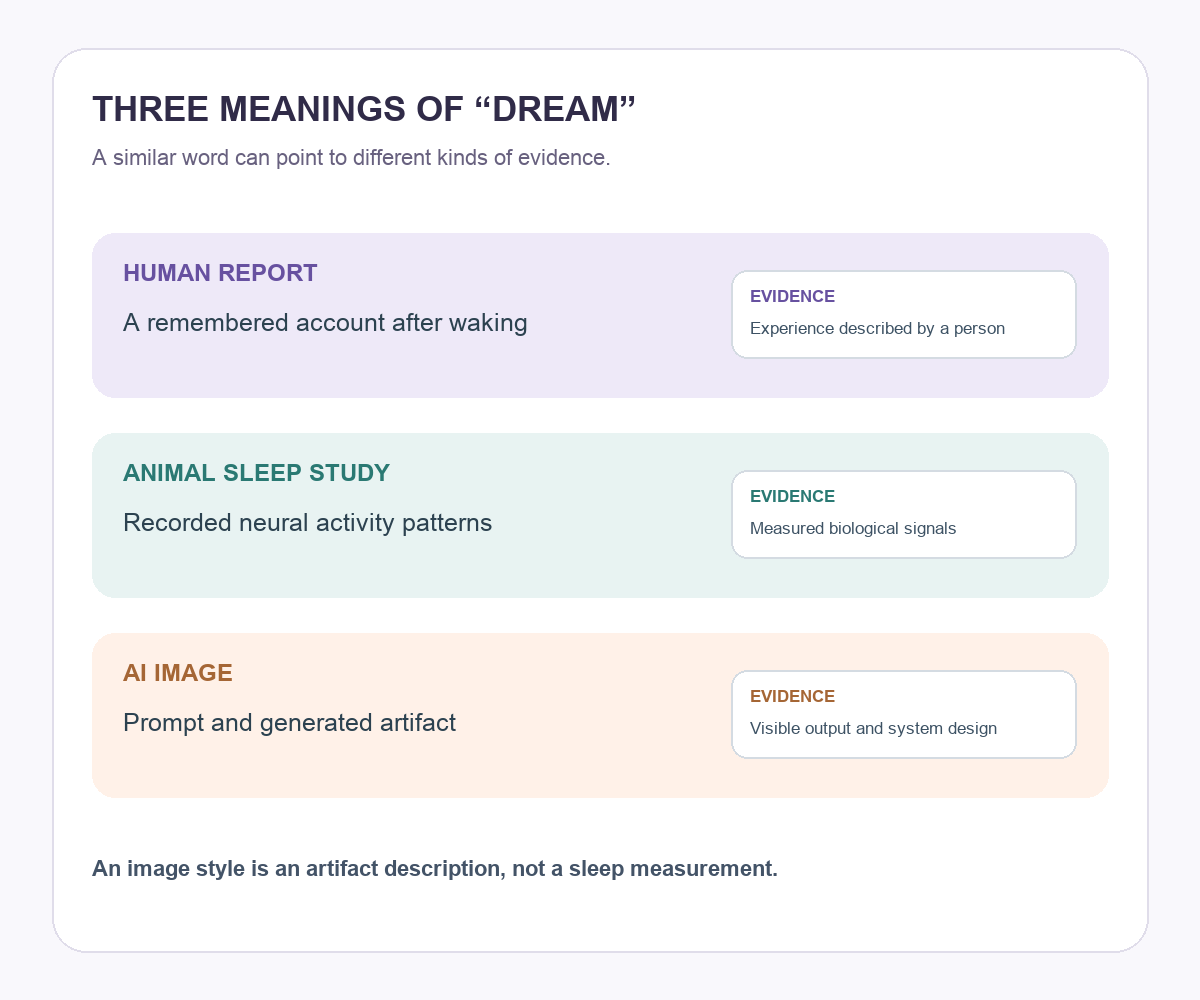
The table keeps three questions apart: pattern recurrence, artifact style, and information reuse. It also keeps the limits of each observation visible.
Ask for a comparison that names its evidence
Compare these three meanings of “dream”: a person's reported experience after sleep, recorded neural activity during an animal sleep study, and a dreamlike image generated by an AI system. For each, state what can be observed, how it is observed, and what remains an interpretation. Use the Wilson and McNaughton 1994 rat study only for the claim it measured. Do not use image style alone as evidence of subjective experience.
Read the returned comparison for changes in subject. “The researchers recorded” should stay attached to neural activity. “The system generated” should stay attached to an output. If a sentence jumps from one to a conclusion about experience, ask what observation would support that step. This is a useful habit beyond this one question: identify the entity, the measurement, and the inference separately.
Use the metaphor with a clear label
There is room to call an image “dreamlike” as a style description. When the conversation turns scientific, label it as a metaphor and ask which claim is being tested. You can appreciate a creative output while keeping the research claim precise. The diagram below gives each meaning of “dream” its own evidence lane.
Try it: Take one sentence that uses “dream” about AI. Rewrite it once as a style description and once as a testable claim. Write down what evidence each version would need.
Two questions to carry into the next discussion
Is a system's idle time sleep? An inactive program and biological sleep are different observations. A comparison needs a clear definition of each state and evidence for the specific property being compared.
Does a dreamlike image show imagination? First decide whether “imagination” refers to creating an output or having an experience. The image demonstrates an output; a claim about experience needs another kind of evidence.
Today's question: Which human word used to describe a machine's operation would you most like to examine?
Related reading in Korean: If an AI says it loves someone, does that imply emotion?
Read the Korean edition of this article.


댓글