An AI assistant asks, “Which part would you like to explore next?” That question can help a conversation continue. A different system might choose its next action because the action is expected to reveal useful information. Both can look curious from the outside. To understand what happened, ask what information the system needed and how its next step was selected.
Human curiosity, a conversational question, and a machine-learning exploration rule describe related but distinct topics. This article compares what you can observe in each case without treating a single sentence as evidence of an inner experience.
What the human study actually examined
In a 2021 Nature Communications study, Ten and colleagues gave participants choices among learning activities and analyzed how they selected tasks over time. Their computational models considered competence and learning progress. In the reported task-selection data, models with a learning-progress component provided the best fit, while competence information helped explain avoidance of easy tasks.
The study offers evidence about human choices in its experimental setting. It does not establish one universal rule for every person's interests, nor does it test whether an AI system has a subjective feeling of curiosity. Keep the participants, measured behavior, and model comparison attached to the claim.
Why engineers use the word curiosity
In machine learning, an exploration mechanism can give an agent a reason to visit a new state or learn where its predictions can improve. A reward is a mathematical training signal in that setting. The visible result might be a new action, a request for more information, or repeated practice on a learnable task. The rule helps describe how an action is chosen; it does not by itself describe a feeling.
Think of choosing the next book in a library. You could choose an unfamiliar subject, a subject you are beginning to understand, or a subject needed for today's task. Each criterion produces a different reading path. The analogy is about the selection rule, not a claim that every AI product literally uses one of these three rules.
| Visible action | Question to investigate | Evidence to inspect |
|---|---|---|
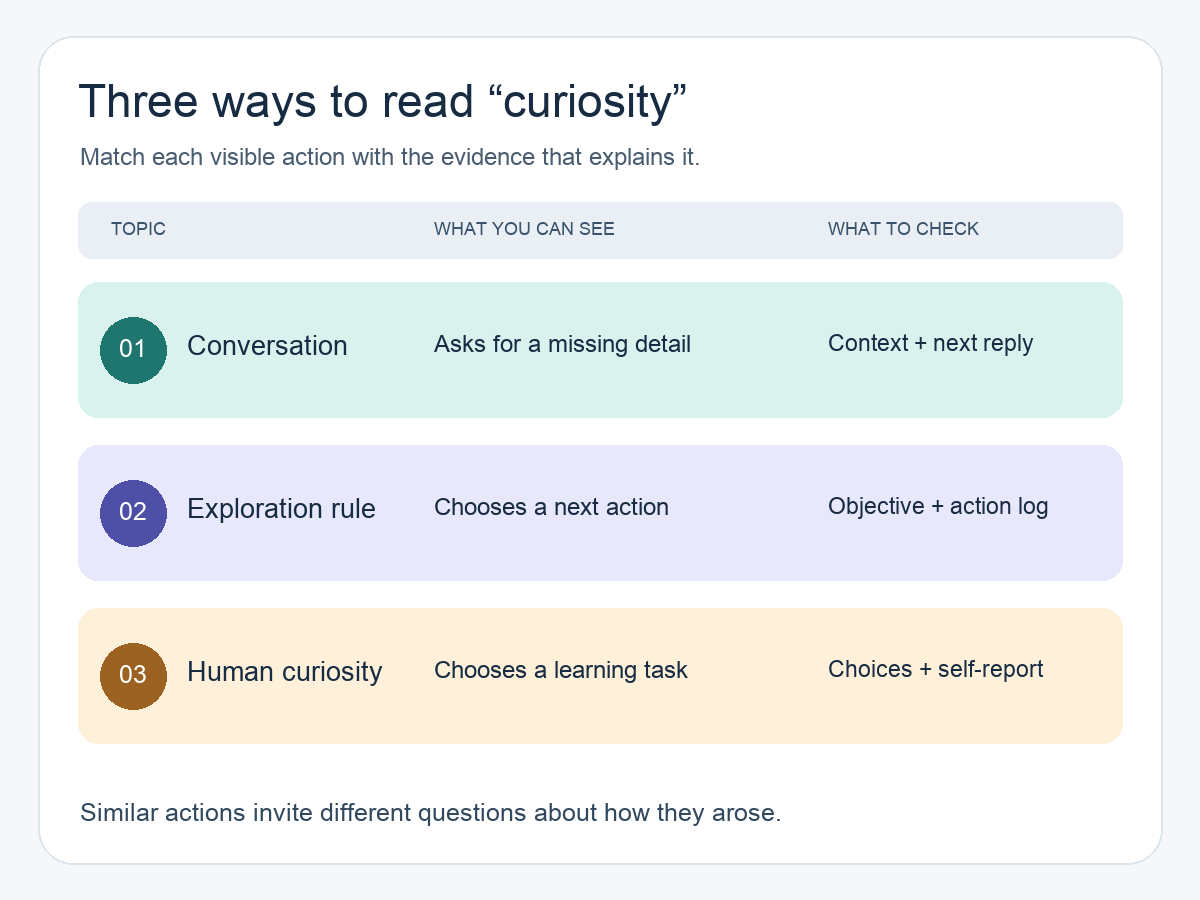
| Asks a follow-up question | What information would help answer the user? | Conversation context and the next reply |
| Explores a new state | What does the exploration rule reward? | Specified objective and action log |
| Repeats a learnable task | Does new feedback change later choices? | Task history and measured progress |
Look for a link between new information and the next step
A phrase such as “I want to know more” is an output that can be read. An information-seeking behavior can also occur without that phrase. For a practical review, trace four stages: the missing information, the selection criterion, the question or action, and how the answer changes what happens next. A count of questions alone tells you less than that sequence.
Try this prompt: “You are helping me choose what to study next. List three possible questions. For each, state what I already know, what new information it might reveal, and how the answer would change my next step. Label assumptions. Let me choose the question.” The response then gives you a visible basis for deciding whether each suggestion serves your goal.
The diagram below separates a conversational follow-up, an exploration rule, and a person's report of curiosity. It highlights which evidence belongs to each claim.
Keep a short curiosity journal
Write down three topics you looked up today and one reason for each choice: novelty, a sense of growing understanding, or a current need. These labels are prompts for reflection, not a personality test or a reproduction of the 2021 experiment. Ask an assistant to suggest a next question for each topic, then compare its suggestions with the question you would choose.
Notice what connects a topic to your own interests and experience. That comparison can help you ask a better follow-up question while keeping the system's suggestion and your personal motivation clearly identified.
Questions about AI and curiosity
Does an AI asking first establish spontaneity? The answer depends on what initiated the question and what “spontaneous” is meant to describe. Inspect the conversation and the system's task before drawing a broader conclusion.
Does an exploration reward mean the system enjoys learning? A reward can guide an optimization process. A claim about enjoyment is a different kind of claim and calls for separate evidence.
Today's question: Which draws you in more: a completely new topic or a topic you understand a little better than yesterday?
Related reading in Korean: How AI and human learning differ.
Read the Korean edition of this article.


댓글