An AI assistant may suggest asking everyone about their availability before choosing a meeting time. The reply can be considerate and useful. Does that mean the system holds consideration as a personal value? To answer carefully, separate the behavior you can read from a claim about an inner commitment. They call for different kinds of evidence.
This article uses a fictional reading-group schedule to compare principles, outputs, and interpretations. It does not claim that any one research method describes every current AI service.
Written principles can guide a response
Researchers can supply a system with instructions or train it using examples shaped by written principles. In Bai and colleagues' 2022 Constitutional AI paper, the authors describe using natural-language principles in a process that generates revisions and preference feedback for training. The paper concerns a method for shaping model behavior. Reading a considerate answer is evidence about the output; the training method is evidence about one way that output patterns can be encouraged.
Keep the research scope visible. The paper examines its described method and evaluations. It is not a direct test of whether a system experiences a principle as a person might. It also should not be treated as an inventory of settings in every product currently available.
One considerate answer can reflect several priorities
Imagine a reading group choosing a meeting place. One member wants a short trip, another needs a quiet room, and a third needs step-free access. A reply that considers everyone could ask for the essential constraints before offering options. Which principle matters most depends on the group's actual needs and decisions. A helpful assistant can make those tradeoffs visible without presenting an unapproved venue as settled.
| Candidate consideration | Question to ask | Observable result |
|---|---|---|
| Travel time | How far can each person go? | Options with stated journeys |
| Quiet setting | Is conversation the main activity? | Options with room conditions |
| Step-free access | Which access features are required? | Options with verified access details |
The table is a planning example. Accessibility details should be checked with the venue's current information before a real event is set. The example demonstrates what a considerate process might ask and show, rather than measuring any assistant's feelings.
Ask for decisions to remain visible
Help us compare reading-group venues. First list the information needed about travel time, room noise, and step-free access. Ask for any condition that would change the recommendation. Then make a comparison table with source and check date for each venue detail. Label any assumption and keep the final choice for the group. Do not make a reservation.
After receiving the table, inspect the cited venue details and decide which conditions are mandatory. If the assistant used a general phrase such as “easy to reach,” ask for the actual travel basis. A considerate tone is useful, while a transparent comparison gives the group something concrete to review.
Use precise language for the two claims
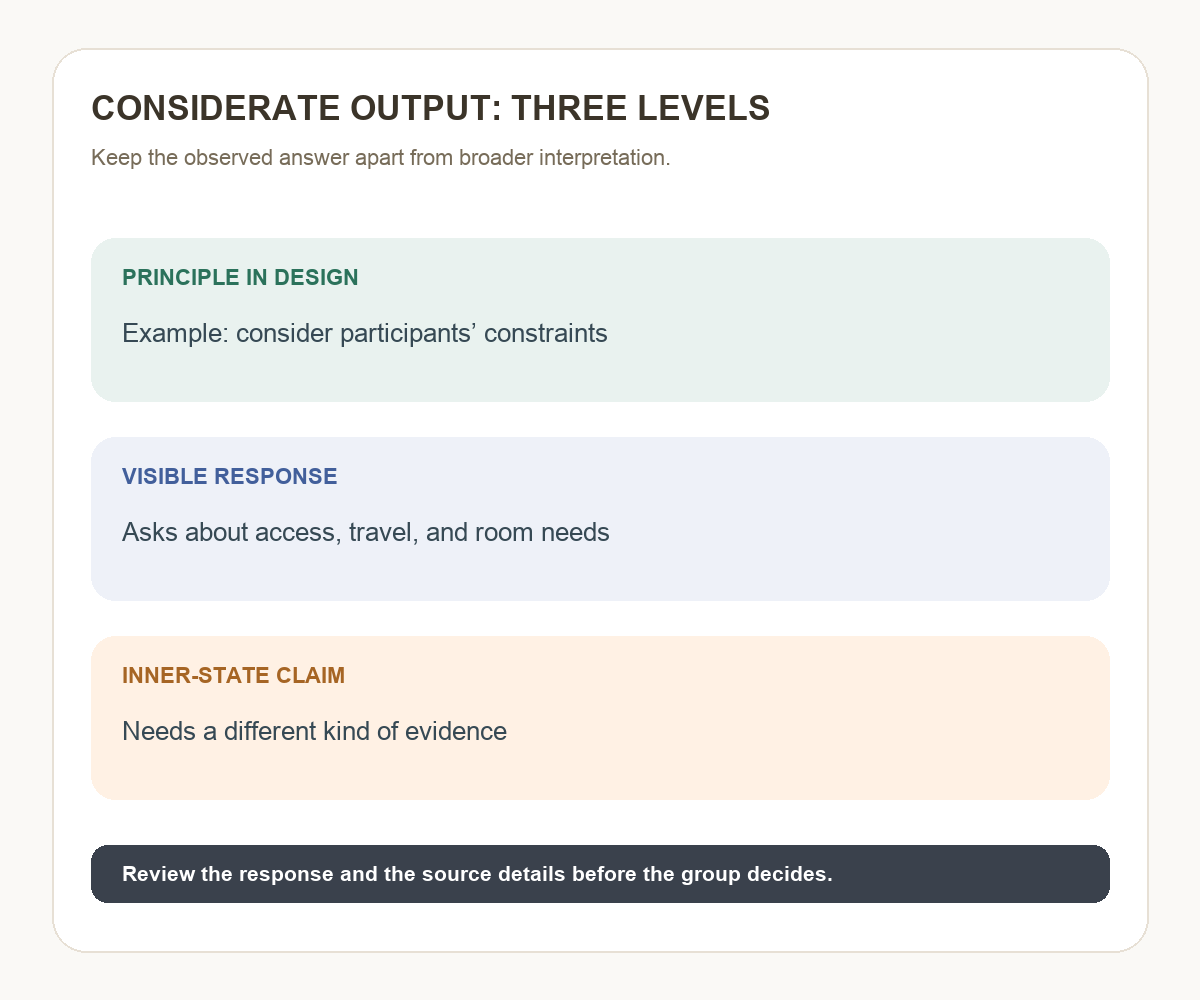
“The assistant produced a reply that considered participants' constraints” describes visible behavior. “The assistant personally values consideration” describes an inner state that the reply alone cannot establish. Keeping the statements separate lets you discuss system design and user experience without assigning an unsupported conclusion about subjective experience.
Try it: Take one AI reply that sounds considerate. Highlight the action it recommends, the principle it appears to apply, and the evidence you can actually inspect. The diagram below places those three levels on separate rows.
Questions about principles and values
Does learning a principle establish a conscience? A principle can shape observable responses. A claim about subjective experience asks for different evidence and should be stated separately.
Does a consistent reply establish a personal value? Consistency is a behavior that can be observed across examples. Training, instructions, and the situation can each contribute to it, so compare those conditions before interpreting the pattern.
Today's question: When you receive a considerate answer, which decision criterion would you ask the assistant to explain?
Related reading in Korean: If an AI says it loves someone, does that imply emotion?
Read the Korean edition of this article.


댓글