Quick answer: Change the explanation for the reader, but keep the underlying facts in one shared list. A beginner needs a first action and plain definitions. A practitioner needs the scope of the rule, decisions to make, and a way to check existing work.
This article uses a fictional file-naming rule to show how to ask an AI assistant for two useful versions of the same guidance. The example is a writing exercise, not a policy for every team.
Start with facts that both versions must preserve
Imagine a team has agreed to name documents as YYYY-MM-DD_topic_v01. The date uses four-digit year, two-digit month, and two-digit day. The topic describes the document, and the first version is v01. A sample file is 2026-10-01_event-guide_v01. Put those facts in a small reference block before asking for either explanation.
| Fixed fact | Example value | Question to leave open |
|---|---|---|
| Order | Date, topic, version | Which documents use the rule? |
| Date | YYYY-MM-DD | Which date does the team record? |
| Starting version | v01 | When does the version increase? |
The rightmost column matters: a prompt should not silently turn an unanswered team question into a settled policy.
Write the beginner version around one completed task
The reader goal is to rename one file. Explain that the date appears first so files can be scanned in date order, then show the three parts of the name. A beginner can follow this sequence: choose the agreed date, write a short topic, add v01, and compare the result with the sample. Define “version” as a marker that distinguishes one saved revision from another. One complete example is more useful here than a list of exceptional cases.
Write the practitioner version around adoption
The practitioner already understands file names. The new questions are operational: does the convention cover existing files, do links or automations refer to old names, and who approves a version increase? Provide a checklist and label unresolved items “decision needed.” For example, renaming a shared file can affect a link in a team document; the practitioner should check that reference before changing the name. These are questions to consider, not extra rules imported into the original example.
A prompt that produces both versions
Using only the file-naming facts below, write two explanations. The beginner version should help someone name one file and define each part. The practitioner version should identify rollout questions, existing references, and decisions the team must make. Keep the date format, field order, and starting version identical. Do not invent a migration policy. End with a list of facts that appear in both versions and questions still awaiting a team decision.
Review the two drafts side by side
Check that a first-time reader can produce 2026-10-01_event-guide_v01 from the beginner steps. Check that the practitioner version names the documents and references to inspect before rollout. Then compare both drafts against the three fixed facts. Their length can differ; the test is whether each reader can take the intended next action without receiving a changed rule.
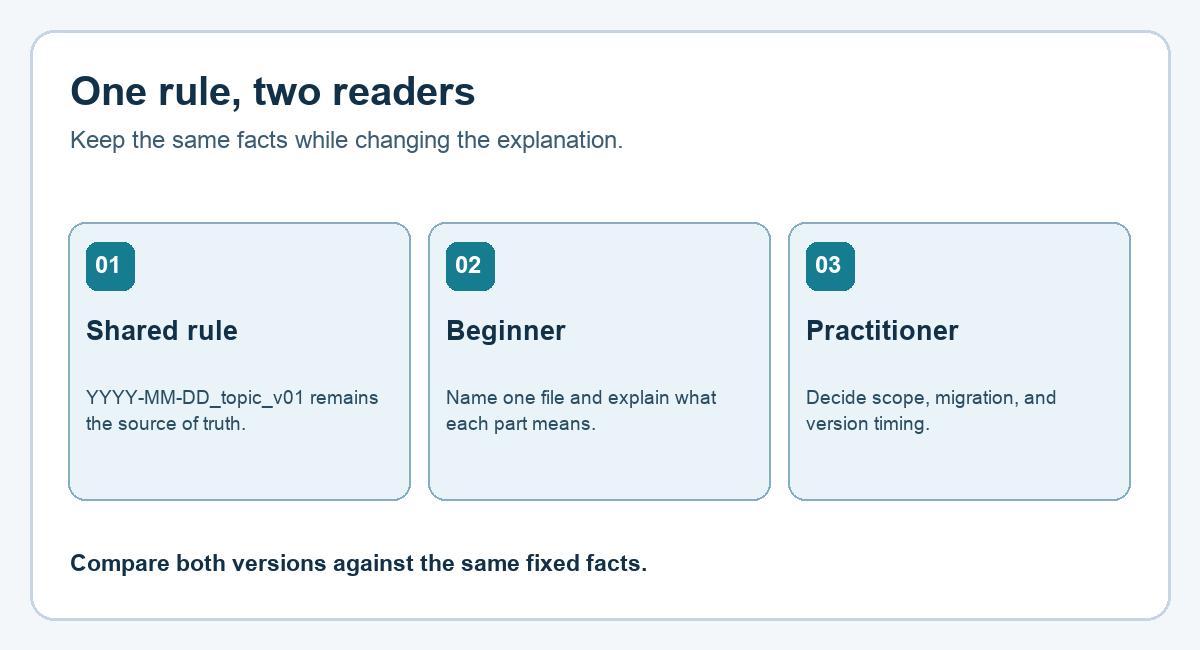
Try it: Choose one instruction you recently shared. Write the facts that must stay constant, then list one action for a new reader and one decision for an experienced reader. The diagram below shows the two paths from the same rule.
Read the Korean edition of this article.
'English Articles' 카테고리의 다른 글
| Turn a Long Notice into Five Informative Cards with AI (0) | 2026.09.23 |
|---|---|
| Organize Research with Chrome Tab Groups: Search, Reading, Sources (0) | 2026.09.23 |
| Design Photo Attachments with Separate Preview and Upload States (0) | 2026.09.23 |
| Practice English with a 10-Minute AI Cafe Role-Play (0) | 2026.09.23 |
| Keep a Note Draft Across Connection Changes: A Three-State App Design (0) | 2026.09.23 |


댓글